
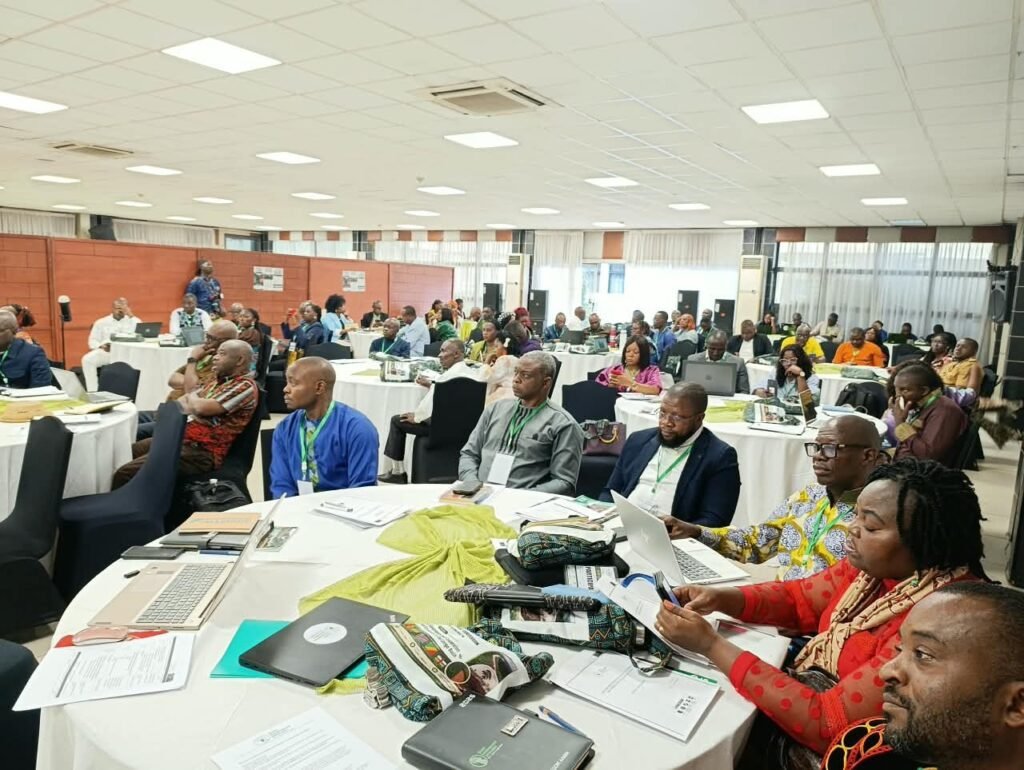
Stakeholders during Yaounde confab on forest conversion
Stakeholders drawn from some countries in the Central African subregion have taken the commitment to reduce the conversion of forest in the Congo basin.
They are resolve to reach their target through the harmonisation of public policies, strengthening of forest governance and promotion of sustainable economic alternatives.
The commitment was taken at the end of a two-day regional workshop on forest conversion. The gathering took place on Tuesday August 18, 2026. The Yaounde forum was organized by the environmental organization, Green Development Advocates (GDA).
The workshop brought together participants such national and regional policy-makers, representatives of international NGOs, technical and financial partners, researchers, scholars, indigenous community representatives and civil society leaders from the Democratic Republic of Congo (DRC), Gabon, Cameroon, Central African Republic, and Congo.
Discursion at the workshop that ended on August 19, was placed under the theme: “Regional governance and cooperation on forest conversion in the Congo Basin”.
According to experts, the forests cover of the Congo Basin, estimated at nearly 300 million hectares of primary or naturally regenerated forests, are home to thousands of plant and animal species, some of which are endemic.
However, over recent decades, the Congo Basin forests have come under increasing pressure due to the conversion of forestland to other uses.
The Coordinator of GDA, Aristide Chacgom Fokam, explained that the two-day gathering analysed the dynamics and impacts of forest conversion in the Congo Basin, strengthen coordination and develop coherent regional strategies to combat deforestation and forest degradation.
He added that they also highlighted innovative tools and traditional knowledge for the monitoring and sustainable management of forests.
“Forest conversion is the process of transforming a natural forest into non-forest land,” he said.
He then explained that: “We invited representatives from countries in the sub-region to examine what is happening in their respective countries and, together, identify strategies that could be put in place to reverse these trends or, where necessary, to ensure that community rights are better taken into account when conversion takes place in the different countries”.
Balancing development and conservation
According to one of the facilitators, Dr Mala A. William, Interim Managing Director of RainForest Alliance, it is important to strike a balance between forest conservation and development needs.
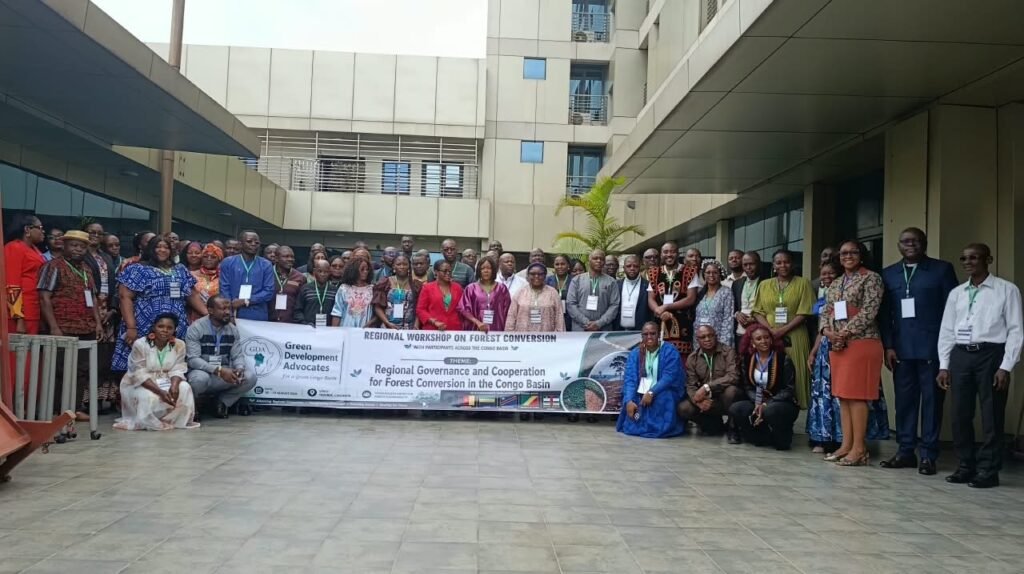
Stakeholders in group photo after workshop opening
The experts advocated for a shift toward integrated land-use planning where all sectors need to exist in order to build growth.
“Growth creates added value and jobs. Sectors must be integrated and integration begins with recognizing that all sectors are important for a country’s development,” Dr Mala said.
“If we take the case of Cameroon, the public investment budget is important. It is nearly 1.4 trillion FCFA, perhaps 1.5 trillion. This public investment budget should be aligned with greening. That is climate change, restoration, sustainable investments, and sustainable communities,” he noted.
‘Forest represent everything to communities’
One of the participant from the Republic of Congo, Guy Moussele Diséke, said the forest represents everything to local communities. Going by civil society leader of the organisation called the Bomassa Association for the Promotion of Culture and Protection of Biodiversity, ABPCPB, the forest serve the communities for various uses including pharmaceutics, source of livelihood, culture and tradition, which are now being threatened by increasing conversion of the forest.
“In the specific case of the Republic of Congo, the country is 65% forested, yet at least 94% of its forests have already been allocated to logging, mining, or agricultural operators,” Diséke told The Guardian Post.
He added that: “In some areas, land that was already granted to a forest concessionaire for logging has since been granted to another operator for mining. There is a real overlapping of concessions across the forests”.
He then used the opportunity to glorify the memory of Dr Djeukam whom he described as a “great leader and mentor” who groomed several CSOs across the six countries of the sub-region.
“He was a great teacher who guided us towards the recognition of rights and, above all, the protection of biodiversity. He was an eminent jurist who truly enabled us to be effective in the work we continue to carry out in his memory” the Congolese activist added.
It is important to note that a recent study estimates that between 1990 and 2020, the Congo basin lost more than 352,000km² of forest cover, representing approximately 8.5 per cent of its total area.
The study attributed this trend to agricultural expansion, mining, infrastructure development, industrial logging and large-scale agro-industrial projects among the main drivers of the conversion.