
By Beryl-Diane Massa
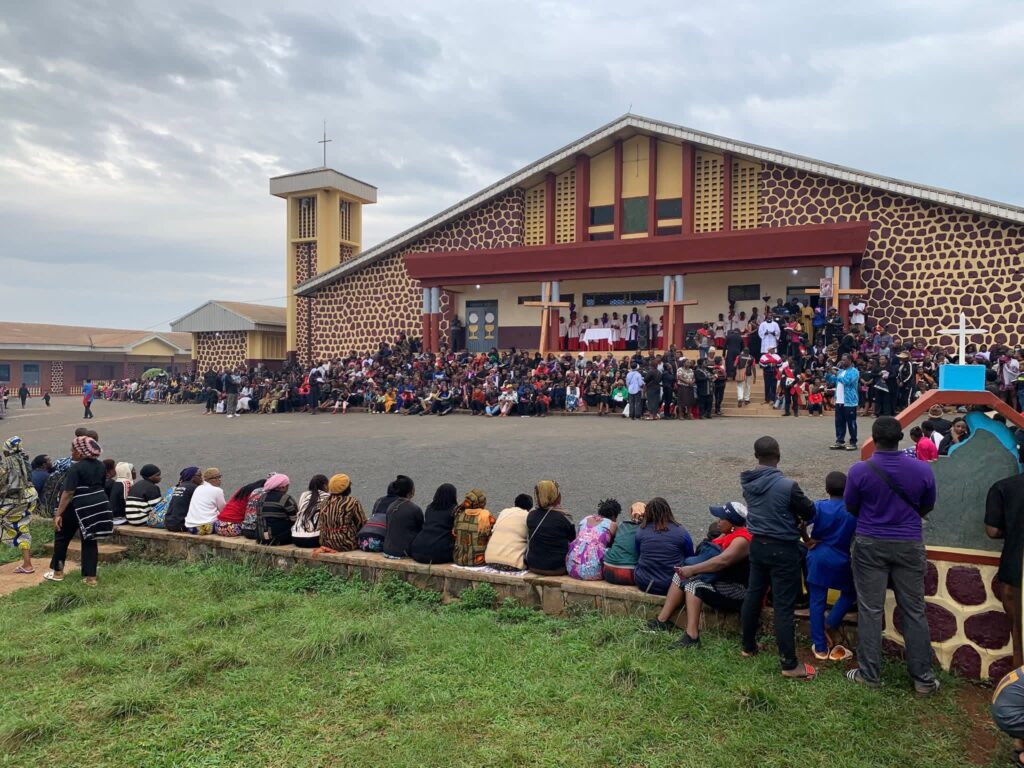
Fai Irene was among the few people in the North West Region present when Pope John Paul II officiated a historic mass on Monday, August 12, 1985, on the tarmac of the Bafut airport in Bamenda.
This was during the first-ever Papal visit to Cameroon from August 10–14 that year.
Fai embarked on a gruelling two-day trek from Misaje to Nkambe, passing through Ndu where she met other Catholic faithful heading to Bafut to attend the mass.
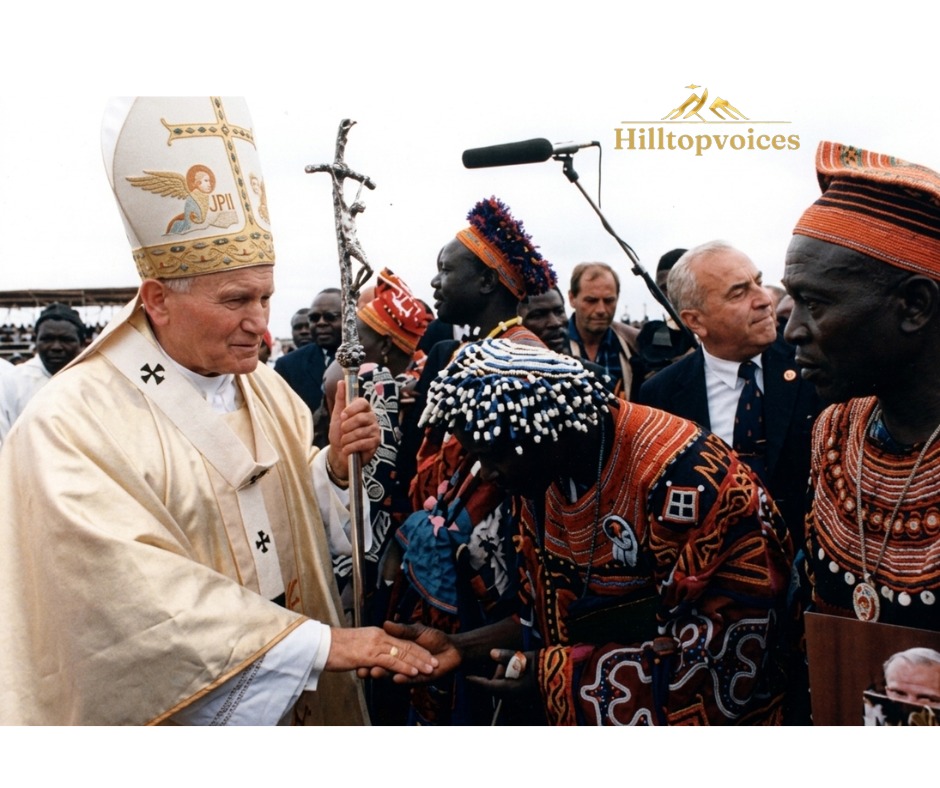
Pope John Paul II during visit to Bamenda in 1985 (Cameroon Archirves)
For 48 hours, Fai said she traversed hills, with her feet aching, trudging through darkness and occasionally sleeping on roadside farms. Her resolve remained unshaken even as her homemade supplies dwindled and hunger set in.
“The journey was too long (…). People were not ready for it,” Fai told CamerToday in an interview, as she looked back across nearly four decades.
Fai and the others reached Bafut a full day before the Pope arrived. That night, under the open sky, she gazed down at her swollen feet, but her face lit up with triumph.
“I was happy I didn’t come alone, even though I walked alone,” she said quietly.
She mentioned that she could not sleep at the airport because of anxiety.
A little over four decades after, Fai, now nearing 80, and frail with age, holds onto hope that she will find the strength to relive the moment when Pope Leo XIV visits the North West regional capital.
Ahead of the visit of the Pope to Bamenda,the Office of the Archbishop has announced some practical tips to facilitate the movements of the Prayer and Action Groups in Church, the clergymen, Christians, actors to take part in the Papal audience, choristers and city dwellers. pic.twitter.com/rnInCXA5zR
— CRTVweb (@CRTV_web) April 13, 2026
The Holy See Press Office announced in February that Pope Leo XIV’s April 2026 Apostolic Journey to Africa will span ten days. The visit will cover Algeria, Cameroon, Angola, and Equatorial Guinea.
As of April 2026, there have been three papal visits to Cameroon, with Pope Leo XIV scheduled to be the third Pope to visit the country from April 15-18, 2026. Previous visits included Pope John Paul II (1985, 1995) and Pope Benedict XVI (2009).
Pope John Paul II visited four cities; Yaoundé, Douala, Garoua, and Bamenda in 1985 before a second visit from September 14-16, 1995 to Yaounde. Pope Benedict , on his part, visited Yaounde from March 17-20, 2009.
Pope Leo XIV is scheduled to visit Bamenda on April 15. His three-day stay in the country will also take him to Yaounde and Douala, the economic capital.
Programme of Pope Leo XIV's visit to Cameroon.#BiyaLeonXIV#PapeAuCameroun2026#PopeInCameroon2026 pic.twitter.com/h2J5ggCxmw
— CRTVweb (@CRTV_web) April 8, 2026
According to the Association for Catholic Information in Africa, in a report first published by the National Catholic Register, over 38 percent of the country’s estimated 30 million people are Catholic, and represent the largest religious group.
The Catholic Church is also one of the largest and most influential denominations in Bamenda, which is the seat of an archdiocese.
Just a word & we shall be healed
Fai said when a Pope [Pope John Paul II] last visited Bamenda, the region was among one of the most thriving in Cameroon. She said the region was “young and loud with possibilities”.
Today, Bamenda’s glory, like most parts of the region, are a distant memory. Their fortunes have nosedived, its once-vibrant streets now a shadow of their former self and its economic heartbeat faltering.
This is because of an armed conflict that erupted in the two English-speaking regions in late 2016.
Lawyers and teachers in the country’s two Anglophone regions organised peaceful protests, complaining of political and economic marginalisation by the central government.
The situation spiralled into violence after the government used force against the protesters, leading to unrest in the North West and South West Regions.
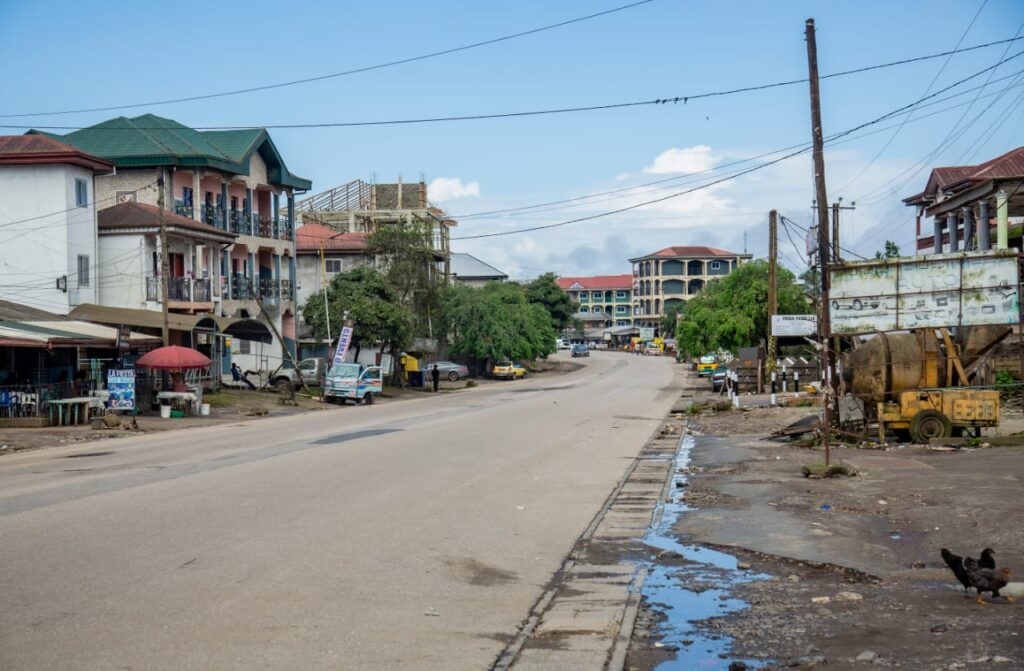
Empty street in Buea during ghost town Monday
Close to a decade later, the conflict has had devastating consequences on the populations and these regions.
Human Right Watch in its World Report 2024 said at least 6,000 civilians have been killed by both government forces and separatist fighters since the violence started.
Government has taken measures to restore peace and normalcy in these regions. In 2019, Cameroon’s President Paul Biya convened a Major National Dialogue aimed at resolving the armed conflict with Anglophone separatists.
Following the dialogue, the government formally enacted a Special Status for the North West and South West regions.
The government also created the National Commission for the Promotion of Bilingualism and Multiculturalism to address language-based discrimination, ensure the respect of bilingualism and strengthen national integration.
The Presidential Plan for the Reconstruction and Development of the North West and South West Regions to rebuild affected communities was also launched with judicial and educational reforms introduced.
But the crisis is still on. For many Bamenda denizens, Pope Leo XIV’s visit to the region represents a beacon of hope amid ongoing armed conflict in the country.
The Archbishop of Bamenda, Andrew Nkea Fuanya, told Vatican News in an interview that: “The Pope comes as a messenger of peace, an ambassador of reconciliation, and a promoter of justice”.
Pope Leo XIV will be a “messenger of peace” for the Cameroonian faithful he will visit from 15 to 18 April. Helping bring that message to life are the countless humanitarian organizations on the ground that, for decades, have prioritised the needs of the most vulnerable. Amongst…
— Vatican News (@VaticanNews) April 12, 2026
“Cameroon has faced many difficulties, and the Pope comes as a messenger of peace. We thank God and the Holy Father, Pope Leo XIV, who has decided that his first visit to Africa will include Cameroon. We are all very, very happy,” the Prelate added.
A Catholic Christian based in Bamenda, who pleaded anonymity, told CamerToday that: “It is more than a visit. It is timely (…) He is Godsent (…) We believe that if he says the Word, we shall be healed”.
Speaking during an event in Douala on Saturday, March 14, 2026, Cardinal Peter Kodwo Appiah Turkson, Chancellor of the Pontifical Academy of Social Sciences and the Pontifical Academy of Sciences, at the Holy See, urged President Biya to surprise Pope Leo XIV, with a reconciliation package for the crisis-hit English-speaking Regions.
According to Cameroon English Language daily newspaper, The Guardian Post, the Vatican official is quoted to have said that outside Cameroon, everyone talking about the country only revisits the deadly conflict that has dragged on for almost ten years.
“…you people have to start thinking of a surprise gift for the Holy Father because everyone outside the country is talking about this conflict,” he said, referring to the chaos that has ruined lives across the former West Cameroon, since the last quarter of 2016.
His Eminence Cardinal Turkson added that: “Let’s give a small gift of a reconciliation progamme prepared by you people to the Holy Father…it will be a great surprise. And for all these, I want to now pray; pray for you and pray with you”.
“This is not a political visit”
The Pope’s visit to Cameroon has sparked debates about its true purpose.
Pope Leo XIV has begun his Apostolic Journey to the African continent with his first stop in Algeria. The Holy Father is expected in Cameroon on Wednesday, April 15, 2026.#BiyaLeonXIV#PapeAuCameroun2026#PopeinCameroon2026 pic.twitter.com/6cpg2TlB3K
— CRTVweb (@CRTV_web) April 13, 2026
While some believe it is to encourage President Paul Biya to redouble peace efforts and resolve the crisis, others believe it is “pastoral.”
Private television channel, Equinox TV, in one of its reports on April 14, said an organisation has written a petition for the release of political prisoners in the country.
But Reverend Father Collins Akinimbom, a priest at the All Saint Bayelle Parish, stressed that: “This is not a political visit”.
Father Collins says: “It is pastoral. He is coming to see the people, to be with them, to listen to them, and to pray with them not only Catholics, but everyone”.
“Now, after years of struggle, the meaning is deeper. He is coming as the vicar of Christ to assure us that even in our difficulties, God is still with us. If your faith is active that day, you will feel it,” Father Collins added.
Fai says she will not be there for the mass like she did 41 years ago. But she has faith that the situation in the Region after the Pope visits again will ameliorate.