
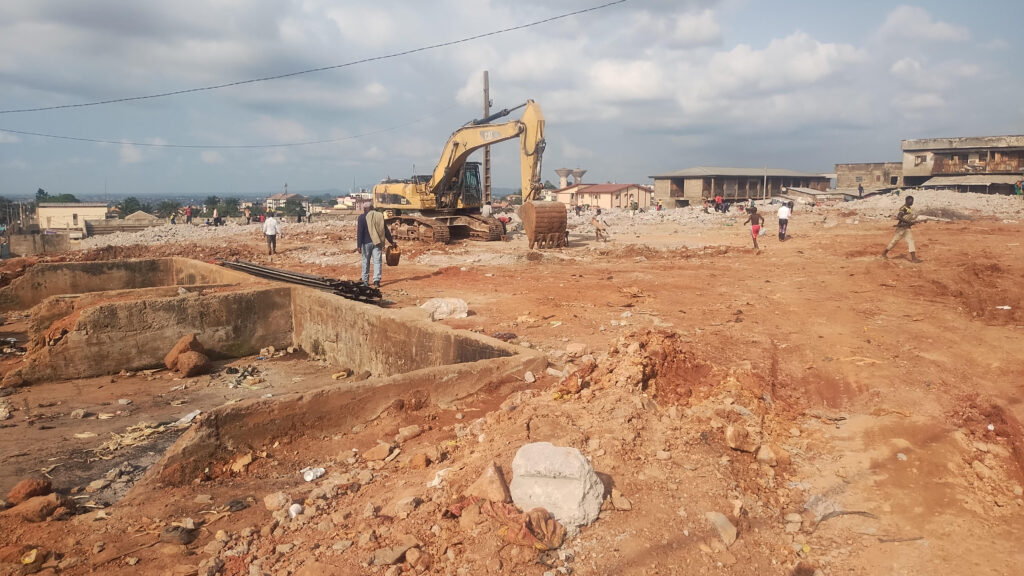
Before most traders had unpacked their goods, bulldozers had begun tearing through the wooden stalls that for decades defined Etoudi Market, one of Yaoundé’s busiest trading hubs. By midday, piles of timber, twisted roofing sheets and clouds of dust had replaced rows of vegetable vendors, fish sellers and small businesses that thousands of residents relied on every day.
For the women who make a living here, the demolition is more than an urban renewal project. It is an abrupt disruption to livelihoods; family incomes and a community built over years of daily trade.
A market disappears overnight
For 11 years, Caroline Mballa known by fellow traders as Mama Caroline, has sold produce at Etoudi Market.
Today, she sits beside the roadside, hoping customers will find her among dozens of displaced traders.
“I have been selling in this market for 11 years. Now look at where I am. Business is not moving here,” she says.
The mother of five says her earnings from the market have long paid her children’s school fees and covered household expenses. Since the demolition began, sales have fallen sharply.
She is not alone.
Across the site, women popularly known as buyam sellam, small-scale traders who buy agricultural produce and resell it in urban markets, say customers have dwindled because the market no longer functions as a single commercial space.
Without permanent stalls, many display their goods on makeshift tables or directly on the roadside, exposed to dust, weather and uncertainty.
Customers are struggling too
The disruption extends beyond traders.
For years, Etoudi Market offered residents a predictable shopping routine. Buyers knew exactly where to find vegetables, smoked fish, spices or household items.
That familiarity has disappeared.
“It is very difficult now to even buy things,” says Rose Nkizo’o, a regular customer.
“We used to have specific places where we knew exactly where to find what we needed. Now the sellers are scattered and we don’t know where to look.”
The fragmentation has reduced foot traffic, traders say, creating a cycle in which fewer customers lead to lower sales, forcing some vendors to abandon the market altogether.
Several have returned to selling within their neighbourhoods despite attracting fewer buyers there.
Urban renewal meets economic reality
The demolition forms part of a broader redevelopment project aimed at modernising commercial infrastructure in Yaoundé.
According to Cameroon Tribune, the commercial complex, valued at more than FCFA3 billion, was launched in 2023 through a partnership between businessman Lonkeu Noubissi and the Yaoundé City Council.
The new three-storey market, under construction on the site of the former Etoudi bus station, will include around 600 shops alongside improved sanitation facilities.
City authorities argue that the project will provide traders with safer and more organised working conditions.
Mayor Luc Messi Atangana has said displaced traders have been offered vacant shops in another section of the newly constructed building and in the nearby Olembe area. He also says they will be prioritised when permanent shops become available after construction, expected to be completed in less than a year.
But many traders say those alternatives remain financially out of reach.
Renting formal shops requires resources that many small-scale vendors simply do not have, especially after weeks of reduced income.
Their frustration is compounded by what they describe as the timing of the demolition.
Some say they expected relocation only after replacement facilities were fully operational, recalling earlier assurances that the old market would remain until traders could move directly into the new complex.
At the demolition site itself, one section has already been flattened. Dust now covers the cleared ground where stalls once stood, while construction of replacement facilities on that portion has yet to begin.
The ripple effects beyond the market
The consequences extend beyond commerce.
Unable to secure alternative spaces, many traders now sell beside the main road, narrowing traffic along one of the busiest routes in Yaoundé I subdivision, located just a few hundred metres from the Presidency.
The roadside trading has created new congestion.
“Cars and motorbikes can no longer move freely,” says Mohammed Habibu, a commercial motorbike rider.
“One can spend about 45 minutes on one spot.”
For transport operators, longer travel times mean fewer trips and reduced daily earnings.
For customers, reaching displaced traders has become more difficult.
And for the women whose businesses depend on regular foot traffic, every additional obstacle translates into another lost sale.
Waiting for a promise to materialize
Markets are more than trading centres.
They are social spaces where relationships are built over years between traders and customers, where informal credit circulates and where thousands of families earn enough to survive.
The redevelopment of Etoudi Market promises modern infrastructure and improved commercial facilities. Few traders oppose that vision.
Their concern is the transition.
Until the new market opens, many remain caught between demolition and reconstruction, navigating shrinking incomes while waiting for the opportunity they have been promised.
For traders like Caroline Mballa, the hope is simple: that the new market will arrive before today’s losses become tomorrow’s permanent hardship.
By Hure Hamidou Abdu