
A new PhD study examining the political economy of Cameroon’s print media has raised concerns over what it describes as the growing culture of “Alleluia Journalism,” warning that economic hardship, political pressures, and an unfavourable business environment are increasingly threatening editorial independence and public trust in the media.
The study, titled ‘The Political Economy of Print Media and Its Impact on Journalism Practice in Cameroon,’ defended by prominent Cameroonian journalist and researcher, Abah Isidore, explores the state, challenges, and prospects of the print media industry in Cameroon. Drawing from in-depth interviews with newspaper publishers across five major cities in Cameroon, the research argues that the fragile economic environment surrounding print journalism is pushing some media organisations and journalists toward praise-singing, biased reporting, and ethical compromise in pursuit of survival.

The thesis identifies the rise of “Alleluia Journalism,” described as excessive praise-oriented reporting often tied to political or financial interests as one of the major consequences of the current media economy in Cameroon. According to the findings, weakened media institutions become increasingly vulnerable to influence from politicians, advertisers, corporations, and other powerful actors, with editorial content sometimes reflecting private interests rather than public interest journalism.
“The current relationship fosters biased reporting and undermines media credibility,” the study notes while discussing the impact of government-media relations and financial pressures on journalism practice in the country.
The research further argues that financial insecurity within the media ecosystem has accelerated the rise of praise-singing journalism in which certain outlets prioritise flattering political or institutional coverage over critical and independent reporting. The phenomenon, popularly framed in the study as “Alleluia Journalism,” is presented as both a symptom and consequence of a struggling media economy.
The study warns that when survival becomes the dominant concern of media organisations, editorial independence is often weakened, opening the door to propaganda, self-censorship, and compromised reporting.
Surviving on shoestring budgets
For years, media owners in Cameroon have complained about what they describe as insufficient government support to private media organisations, arguing that the sector operates in an environment that neither protects journalism nor encourages media businesses to thrive. Although the government provides annual public aid to private media houses, publishers and media practitioners have repeatedly argued that the support remains inadequate, and incapable of addressing the deeper structural problems confronting the industry.
In 2024, Ngah Christian, Publisher of the leading English-Language daily and President of the Cameroon English Language Newspaper Publishers Association (CENPA), described the government’s financial support to the sector as grossly inadequate, especially given the rising costs of production and taxes.
“You know, whenever the government is announcing the so-called subvention to the private media, to us in the private media, it is a period to mourn,” he told News Central.
“With the advent of social media, newspapers no longer sell on the newsstands. And when someone is desperate, they can go for anything. That is why you have publishers who are poor like we are today…” he had told The Guardian Post a year prior.
In alignment with the concern, the recent study on Cameroon’s newspaper economy study notes that many newspapers struggle with poor sales, low purchasing power among readers, high printing costs, weak advertising culture, poor circulation systems, and the absence of modern distribution infrastructure.
The findings reveal that although more than 700 newspapers have reportedly been authorised in Cameroon, fewer than 20 publish regularly, raising broader questions about sustainability within the sector. In many cases, publishers are forced to operate on extremely limited budgets while simultaneously dealing with a difficult regulatory environment, inconsistent access to official information, and what several previous media studies have described as increasing economic vulnerability within newsrooms.
Other studies cited in the thesis similarly suggest that poverty and newsroom precarity have contributed significantly to the normalisation of “gombo journalism,” the practice of accepting money or favours in exchange for media coverage.
Print media not yet defeated
Despite the grim realities facing the sector, the thesis argues that print journalism in Cameroon still retains important strengths capable of sustaining its relevance in the digital era. These include professionalism, fact-based reporting, ethical rigidity, credibility, and the ability to produce in-depth journalism often lacking on fast-moving social media platforms.
Unlike digital platforms driven largely by speed, virality, and instant reactions, the study notes that newspapers still provide room for context, verification, and analytical reporting. To survive, many publishers are increasingly turning toward digital visibility strategies, subscription models, online advertising, partnerships, and diversification into other businesses to support newsroom operations.
The study also recommends reforms including the review of restrictive media laws, decriminalisation of press offences, improved access to public information through a Freedom of Information Act, reform of the National Communication Council, and stronger institutional support for private media organisations. For Cameroon’s media landscape, the study suggests that the future of journalism may depend not only on technological adaptation, but also on whether the country can create political and economic conditions that allow independent journalism to survive.
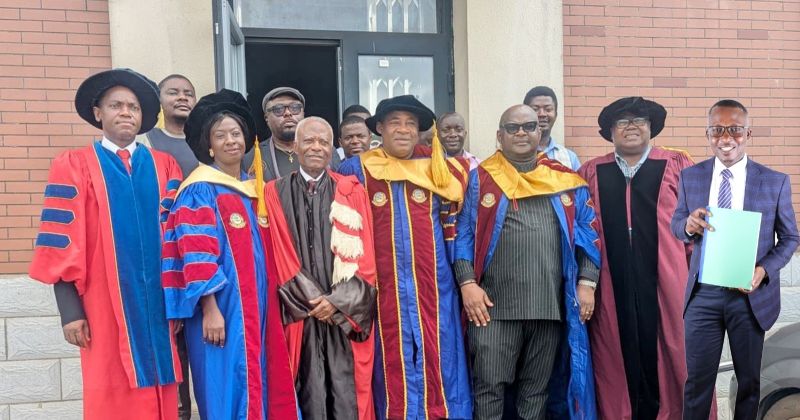
Journalist Abah’s PhD defense, it should be noted, was the first ever to be done online in the university of Buea’s Department of Journalism and Mass Communication. Members of the jury included Professor Boyomo Assala Charles as chairperson; Professor Thomas Atenga as rapporteur I; Professor Julius Che Tita as Rapporteur II; Professor Kingsley Ngange as Supervisor; Prof Nengieh Lizzie Wantchami as Co-supervisor and Prof Nkongho Ta-Mbi as member.