

The blank page is often the hardest part.
For a third-year journalism student in Cameroon, the greatest challenge has never been finding a story. It has been finding the first sentence.
“My biggest challenge since studying journalism has been to find a good and catchy hook to start all the stories I write,” she says. “Sometimes, I’m forced to write many times and cancel just to find the best hook.”
It is a frustration familiar to many young reporters. They spend years learning media law, ethics and reporting techniques in lecture halls, but when faced with a real audience, deadlines and editorial expectations, theory alone is rarely enough.
Across Cameroon, journalism schools continue to produce graduates every year. Yet many leave without a published portfolio, professional mentors or newsroom experience that could ease their transition into the profession. As the media industry rapidly evolves through digital platforms, artificial intelligence and changing audience habits, that gap between education and practice is becoming increasingly difficult to ignore.
It is within this space that the Camer Today News Project (CTNP) has positioned itself, not as a journalism school, but as a bridge between the classroom and the newsroom.
Closing the experience gap
For many journalism students, the challenge is not simply acquiring knowledge. It is finding opportunities to apply it.
Students spoke to CTNP describing their academic journey as demanding but often disconnected from the practical realities of modern journalism.
“With the training, which is very strenuous and time-consuming, student journalists lack the opportunity to work on themselves,” one student explains. “They can only hope to do that when they start working.”
The transition, however, is often difficult. Entry-level opportunities are limited, internships are highly competitive, and many graduates struggle to demonstrate experience because they have had few opportunities to produce work outside the classroom.
CTNP was created to address this problem precisely.
The initiative, operating under Camer Today, supports journalism students and recent graduates through practical reporting opportunities, editorial mentorship and publication platforms. Rather than focusing solely on classroom instruction, it encourages participants to report, write, revise and publish stories that respond to real public issues.
Its emphasis is on developing journalists who are not only technically competent but also ethical, curious and solutions-oriented.
Why stories matter more than headlines
Unlike many student competitions that reward breaking news reports, CTNP has deliberately centred its flagship initiative on feature writing.
The choice reflects a broader philosophy about journalism.
Feature reporting demands patience. It requires journalists to investigate beyond official statements, understand context, spend time with communities and tell stories that reveal how public issues affect everyday lives.
In an era dominated by fast-moving news cycles, feature writing offers space for nuance.
For CTNP, encouraging this style of reporting is also a way of promoting solutions journalism, an approach that examines not only problems but also credible responses and innovations emerging within communities.
The objective is to help young journalists move beyond simply describing challenges and instead produce reporting that informs public understanding in meaningful ways.
Recognition as a pathway, not the destination
Competitions are often viewed as celebrations of individual achievement.
For many young journalists, however, they represent something much more practical: visibility.
“Journalism competitions matter because they are one of those rare opportunities journalists have to make names for themselves,” says another student.
“They improve visibility as well as CVs; some journalists may not even undergo extensive training, but through competitions, they are revealed to the world.”
That perspective has informed CTNP’s partnership with the 2026 Victoria International Media Merit Awards (VIMMA).
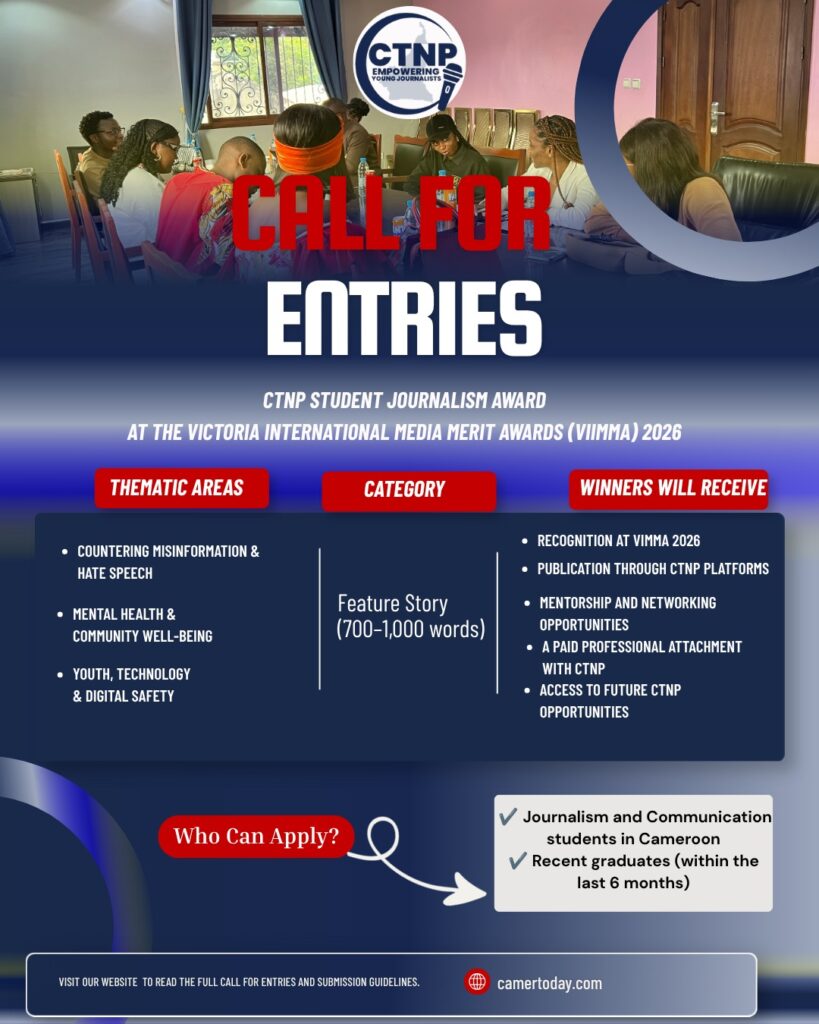
Rather than limiting rewards to certificates or cash prizes, the initiative links recognition to professional development.
Winning participants will receive publication opportunities through CTNP platforms, mentorship from experienced journalists, access to professional networks and, notably, a paid attachment within the Camer Today News Project.
Outstanding participants may also be considered for future reporting assignments, fellowships, specialised training programmes and membership in the CTNP Emerging Journalists Network.
The approach reflects an understanding that recognition alone rarely changes careers; continued support often does.
Investing in journalism before journalists graduate
Cameroon, like many countries, faces growing challenges around misinformation, declining public trust and rapidly changing digital media ecosystems.
Preparing journalists to navigate these realities requires more than technical instruction.
CTNP says its objective is to cultivate qualities that remain essential regardless of technological change: critical thinking, ethical judgement, verification skills, curiosity and the ability to tell compelling human-centred stories.
Supporting journalists early, while they are still students or recent graduates, allows those values to develop before professional routines become entrenched.
The hope is that participants leave not simply as stronger writers, but as reporters capable of producing journalism that serves the public interest.
Building tomorrow’s newsroom today
Every journalist remembers the opportunity that opened the first door, a mentor who edited the first story, an editor who took a chance on an unpublished writer, or a competition that transformed an unknown student into a recognised byline.
For many aspiring journalists in Cameroon, such opportunities remain rare.
CTNP is betting that creating more of those moments can strengthen not only individual careers but also the country’s media landscape.
The student still searching for the perfect opening line may one day write stories that shape national conversations. What they need first is somewhere to begin.
For a growing number of young journalists, that beginning may no longer be confined to the classroom. It may start with a published story, an experienced editor willing to mentor, and a newsroom prepared to invest in potential before experience.