
An ideal journalist is rough on the edges but fine on the inside.
Sometime around 2020, while running a small joint in Buea, we got into trouble with the forces of law and order for allegedly hosting a party during the COVID-19 lockdown. To be fair, it wasn’t a party per se, but the men in uniform weren’t there for nuance.
Our identification papers were seized, and one particularly dramatic officer who had cracked his rifle was not having it. He would not listen and for a second, I imagined he was one of the trigger-happy ones.
For a second, I saw my life flash before my eyes.
Then survival mode kicked in.
Derek and I approached the officer who seemed to be the boss. He stood silently by the car door, watching the chaos unfold. As I was still debating what to say, Derek jumped right in:
“Grand, we be get money but we don finish am on top charge. See all that whiskey them for table. We hold na this 3,500 for hand but I no fit give you because we need for pay these girls their transport for go back for house…”
I did not know whether to laugh or to scream. He was speaking the truth but the delivery was wild.
We ended up walking free and one of the gendarmes even cracked a joke about giving the girls a lift home. All 8 to 10 of them. Afterall, their truck is paid for by our taxes.
Another gave us a tip on how to deal with men in uniform and trust me, it has worked more times than I can count.
How far can you go to get what you want? How honest can you be when your life might hinge on diplomacy or bluff?
Charlie Ndi Chia offers his own answer in Chapter Three of Ink in My Blood. Calling his time at the state broadcaster a “mixed bag,” he writes of surviving in a system laced with suspicion.
“There was a palpable sense of distrust, and I often felt like an outsider, especially as an Anglophone journalist in a predominantly Francophone environment.”
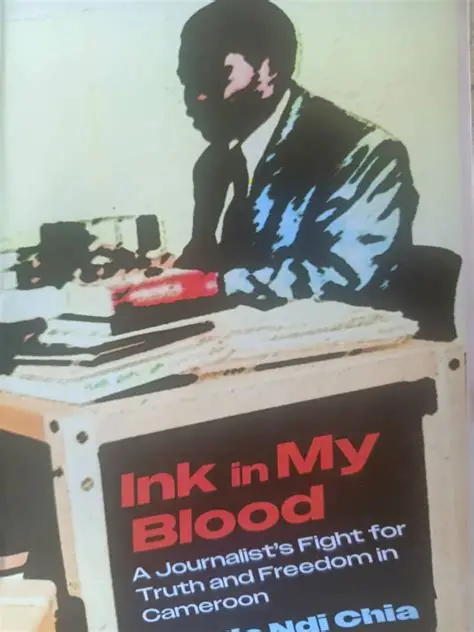
These are Uncle Charlie’s words, but they echo the daily reality of many Anglophones in Cameroon. Across the country? Yes. Inside the state broadcaster? Not my place to say. Their circus, their monkeys.
Some four decades on, the feeling hasn’t changed. If anything, the writing on the wall is now carved in the blood of thousands who have paid too high a price, be it for separation or unity.
***
The Crucifier of Men had a close call with unmaking when he used his Letter from the East segment to express his dislike for the President live on National Radio. He would later slip into self exile in Nigeria shortly before the 1992 Presidential election. Yes, the same one the SDF never stops romanticising over for obvious reasons.
One steady companion in Charlie’s journey is the bottle, showing up in both chaotic and curiously pragmatic moments. Whether being used as mosquito repellent a Douala detention facility or ‘arming’ him for a tense crossing into Calabar, alcohol gets its place. If I weren’t a journalist myself, I’d have asked what’s really in it.
When he returned home, Uncle Charlie disregarded his father’s counsel that he returns to the state broadcaster. He chose the Cameroon Post only to discover it plagued with internal conflicts and financial difficulties. This set him on the path to the creation, rise and politicising of The Post newspaper. He called this segment building and rebuilding.
Uncle Charlie wrote like a man with nine lives and a grudge against authority. For someone who seemed destined to command newsrooms, I was eager to see him set the example when he had the chance to take charge at The Post. But when the moment came, he shrugged off the weight of leadership and opted for journalism over administration.
Classic Charlie: allergic to chains, even the ones he could’ve held the keys to.
Apparently…
Check our part IV here or read part II in case you missed on
————————————————-
Giyo Ndzi is a Cameroonian journalist and storyteller passionate about truth-telling and media freedom. His newsroom experience spans different outlets, including The Guardian Post where he served as reporter and later Desk Editor.
He continues to write and reflect from the crossroads of journalism, advocacy, and lived experience.
Pingback: [Ink in Charlie's blood: Le decryptage - II] Against the Grain: The making of a rebel scribe - Camer Today
Pingback: [Ink in Charlie's blood: Le decryptage - IV] Unprotected witnesses: When the wolves come for the press - Camer Today